Sidingthat protects what's behind it
We remove the old material, inspect what's underneath, and install new siding built to hold up to Northeast Florida's sun, rain and humidity. Free inspection, no-obligation estimate.
Your exteriorgoes through a lot down here
Here in Northeast Florida, you know how much your home’s exterior goes through. Between the strong sun, heavy rain, humidity and random storms, your siding takes constant hits.
Quality siding doesn’t just make your home look better. It protects everything inside it. When properly installed, siding helps shield your home from water damage, wind, pests and rising energy costs. It’s one of the most important layers of protection your home has.
Jacksonville sees around 114 days of measurable rain and roughly 52 inches a year, and nearly 40% of that falls between June and August. That is a lot of water arriving fast, against walls that spend the rest of the year in full sun.
Siding installationstart to finish
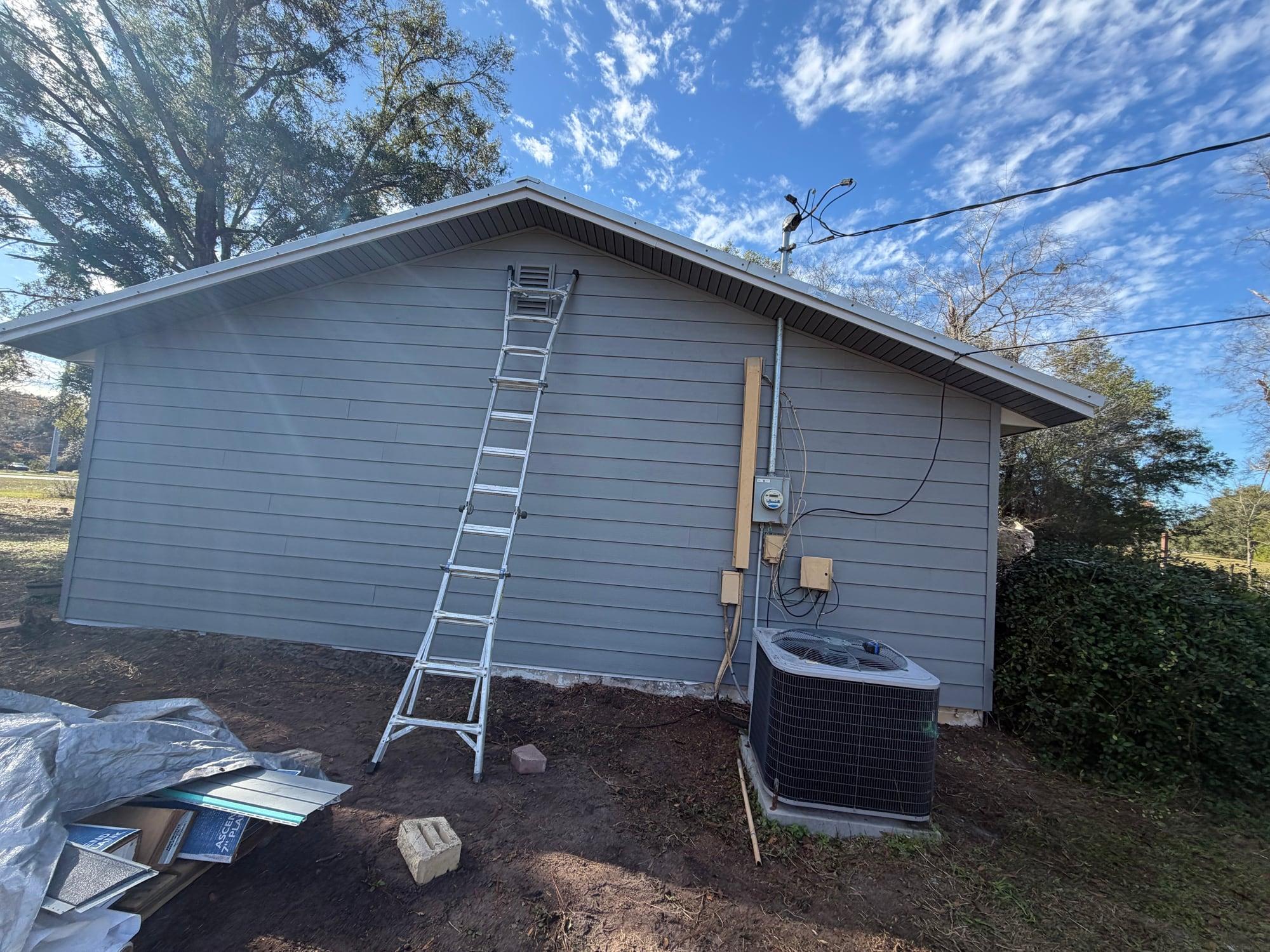
Our team handles your siding project from start to finish. We remove old and damaged materials, inspect for underlying issues, and install new siding the right way. We make sure everything is secure, sealed and built to last.
Whether you’re looking for a simple refresh or a full exterior transformation, we’ll help you choose an option that fits your style and your budget. We focus on clean lines, proper installation, and the details that make a real difference.
Call or text (904) 707-6546 and we will come out, look at what you have, and put an estimate in writing. The inspection is free and the estimate carries no obligation.
The material choiceand how each behaves here
Most homeowners come to us deciding between three families of siding. None of them is the automatic right answer. The honest comparison is cost against maintenance against how the material handles our heat, humidity and UV. We walk through all three on site.
Fiber cement
Dimensionally stable in humidity and it will not feed termites or rot. Heavy to hang and it wants properly sealed cut edges, which is where a rushed install shows up two summers later.
Vinyl
The lowest-maintenance and usually the lowest-cost option. It expands and contracts a lot in our temperature swings, so it has to be hung with the correct slack: nailed tight, it buckles.
Engineered wood
Gives you a real wood look with better moisture resistance than solid timber. The factory finish and the sealed ends do the work, so the details at trim, corners and ground clearance matter most.
Whichever you pick, the install is what decides how long it lasts. Salt air along the coast in Fernandina Beach and Amelia Island is harder on fasteners and trim than it is twenty miles inland, so we specify accordingly rather than running the same detail on every house.
James Hardieis the fibre cement we offer
Fibre cement is the family homeowners ask us about most, and James Hardie is the line we put on houses. The boards are cement, sand and cellulose fibre (not wood, not plastic) and that composition is most of the reason they suit this climate.

The James Hardie logo is a registered trademark of James Hardie Technology Limited.
Our walls spend most of the year in full sun. Fibre cement does not soften, warp or lose its shape in that heat the way a plastic-based cladding can, and the factory finish, ColorPlus® Technology, is applied and cured in the plant under controlled conditions rather than rolled onto a hot wall on a July afternoon. A finish that cured indoors behaves differently under UV to one that cured in the sun on your house.
Humidity is the harder test, and it is the one wood loses. Timber siding and timber trim take on moisture, swell and shrink, and down here they rarely get a dry enough stretch to recover before the next storm. Fibre cement is dimensionally stable through that cycle, so butt joints, corners and trim details stay where they were installed. That matters more than it sounds: wind-driven rain is not falling on your wall, it is being pushed at it, and it goes straight into any gap that opened up after the install.
It also gives pests nothing to eat. Termites, carpenter ants and wood-boring beetles eat wood, and there is no wood in a cement board to eat. On most of the houses we take siding off, the wood trim, fascia and soffit are further gone than the walls are, which is why we will often specify HardieTrim® and HardieSoffit® on a house whose main walls we are leaving alone.
None of that survives a careless install. Cut edges get sealed, ground and roof clearances are held, joints and penetrations are flashed, and the boards are fastened to the manufacturer’s pattern rather than to whatever is fastest. We install it to James Hardie’s published instructions because that is the only version of the product that behaves the way the material is meant to.
The productswe install from the range
Most exteriors use several of these together: walls in one profile, gables in another, and the trim and soffit tying them in. We will price the combination you want on your elevation rather than quoting one board and leaving the rest to be argued about later.
HardiePlank® lap siding
The horizontal lap board most people picture when they picture fibre cement, and the most common Hardie product on a Northeast Florida house. Available in several widths and textures, including a smooth profile and a wood-grain one.
HardieShingle® siding
Shingle-look panels and individual shingles for gables, dormers and accent elevations. It is the way to get the coastal cottage look our older Fernandina Beach and Amelia Island streets are full of without owning real cedar.
HardiePanel® vertical siding
Large vertical sheets. Used on their own for a flat, modern elevation, or run with battens over the joints for board-and-batten, which is the look most new builds around here are asking for.
HardieSoffit® panels
Vented and non-vented panels for the underside of the eaves. Soffit is where wood rot usually shows up first on a Florida house, because it sits in shade, catches wind-driven rain and never really dries.
HardieTrim® boards
Corners, columns, window and door surrounds, fascia and frieze boards. Trimming a fibre cement wall in wood puts the softest material at the most exposed edges, which is exactly backwards.
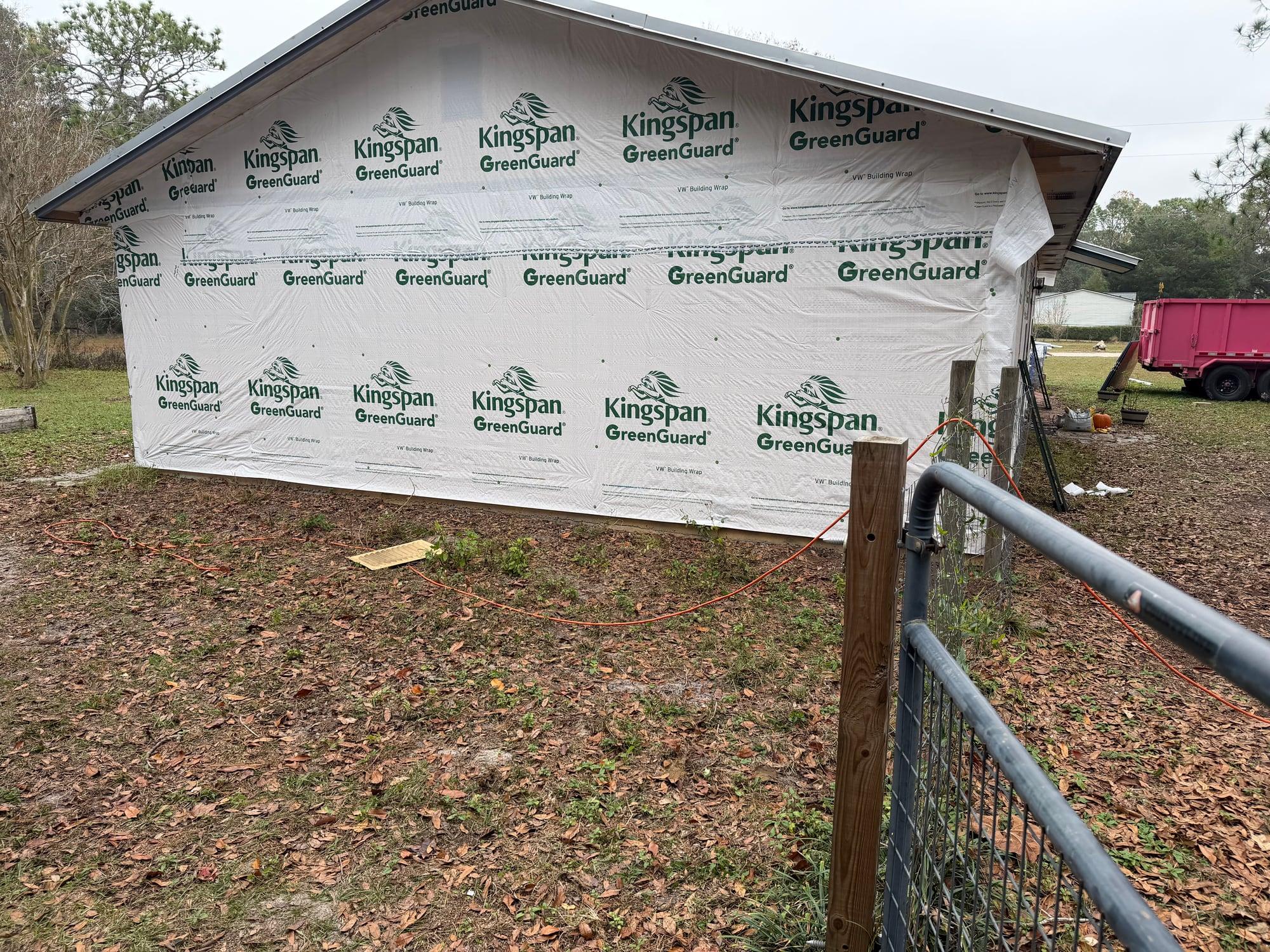
HardieWrap® weather barrier
The barrier that goes on over the sheathing, behind the siding. It is the layer actually doing the work once water gets past the cladding, and it is the part nobody sees again for twenty years.
Boards come either with the ColorPlus® factory finish or primed for painting on site. If you want the painted route, we do exterior painting in-house, so the siding and the finish are one project on one schedule instead of two trades and two invoices.
What the tear-offusually turns up
Siding is the layer you can see. The layer that matters is the sheathing, the weather barrier and the framing behind it, and the only way to know their condition is to take the old siding off and look. That inspection is part of every siding job we do. It is not an upsell, it is the point.
The most common find is wood rot: softened sheathing under a leaking window, a bottom course that has been wicking ground moisture for years, or fascia and trim that failed where the roofline meets the wall. Northeast Florida’s humidity keeps wet framing wet, so small intrusions do not dry out on their own.
When we find it, you get photographs before anything is covered back up, along with what it will take to put right. Because we hold a Certified Building Contractor licence (CBC1270530) as well as a Certified Roofing Contractor licence (CCC1335155), we repair it ourselves and keep going. You are not left holding an open wall waiting on a second contractor.
Repair or replace?Eight things we look for
One of these on one wall is usually a repair. Several of them across the house means the siding has done its job and it is time to talk about replacing it. We will tell you which side of the line you are on, and show you the photos that got us there.
Cracking or splitting
Panels that have split are no longer a weather barrier, and water gets behind them every storm.
Warping or buckling
Waves and bulges usually mean moisture behind the siding, a failed fastening pattern, or both.
Fading and chalking
Colour that has gone flat and leaves powder on your hand has lost its UV protection layer.
Moisture spots inside
Stains on interior walls that track back to an exterior wall are a siding or flashing problem until proven otherwise.
Soft spots and rot
If a screwdriver sinks into trim, fascia or the wall behind it, the substrate is the real job.
Visible storm damage
Wind-lifted, cracked or missing panels after a storm should be looked at before the next one.
Rising cooling bills
Failed siding often means a failed weather barrier behind it, and that shows up on the power bill.
Pests getting in
Gaps at corners, joints and the bottom course are how insects and rodents reach the wall cavity.
Siding and paintare usually one decision
A lot of the calls we get about repainting turn out to be siding calls, and a fair number of siding calls turn out to be solved with paint. Peeling and chalking on sound siding is a finish problem. Peeling over a wall that is still taking on water is not, and repainting it just buys a season.
We do both in-house, so the inspection answers that question honestly rather than steering you toward whichever job we happen to sell. If new siding is going on and it needs a finish, we can price the siding and the paint together as one project on one schedule.
Other residential servicesfrom the same crews
Sidingquestions we get asked
Common signs include cracking, fading, warping, moisture spots inside the home and visible storm damage. Any one of those on its own can sometimes be repaired; several of them across different walls usually means the siding has reached the end of its service life. The reliable test is what is behind it: if the sheathing or framing has taken on water, replacing panels alone just covers the problem back up.
Most siding installations can be completed within two days, depending on the size, location and complexity of the project. Two-story homes, heavy trim detail and hard-to-reach elevations add time, and so does anything we find once the old material is off. We give you a timeline in the estimate before we start, and if the tear-off changes it we tell you the same day.
We stop, photograph it and show you before we cover anything back up. Wood rot behind siding is common in Northeast Florida and it is the single most frequent reason a siding estimate changes mid-job. Because we hold a Certified Building Contractor licence as well as a roofing licence, we can repair the sheathing, framing or trim ourselves rather than sending you to a second contractor and pausing your project for a week.
There is no single right answer. It depends on your budget, your home's style and how much maintenance you want to do. What matters more than the material is that it is installed for our climate: correct expansion allowance, sealed cut edges, proper ground clearance, and a working weather barrier behind it. We will walk you through the trade-offs of each option on site and price the ones you are actually interested in.
Often, yes. Partial replacement makes sense when the damage is contained to one elevation and the rest of the siding is sound. The honest caveat is colour: siding fades with UV exposure, so new panels rarely match aged ones exactly, even in the same product and colour. We will tell you up front whether a patch will be visible so you can decide before we order material.
We can. Some siding arrives with a factory finish that should be left alone, and some is designed to be painted on site. We handle exterior painting in-house with Sherwin-Williams products, so if your project calls for paint we can price the siding and the finish together as one job rather than coordinating two trades.
Yes, where the local building department requires one. We work with all county, city and municipality building departments across Northeast Florida, including Duval, Nassau, Clay and St. Johns, and we will never perform unpermitted work on your home. We pull the permit, schedule the inspections and see them through to final sign-off.
Ready to look at siding?Free inspection, no obligation
Call or text us and we'll come out, look at what you have, and send you an estimate with photos of anything we found. No trip fee.
Call or text · Available 24/7