
Jacksonville Beachpermits its own roofs
It is a Duval County address, but it is not a City of Jacksonville permit. Jacksonville Beach runs its own building department, with its own roof application and its own portal, and a mile of salt air that treats a roof very differently from one in Mandarin.
Its own cityits own building department
Jacksonville Beach is an incorporated municipality inside Duval County, and permitting here runs through the City of Jacksonville Beach’s Planning and Development Department, specifically its Building Inspection Division on North Third Street. Jacksonville does not permit here, and its own homeowner permitting page says so.
The city publishes a dedicated Roof Permit Application rather than folding roofing into a general building form, and takes submissions through its own portal, C.O.A.S.T. The Florida Building Code, 8th Edition (2023) is in effect. If you are acting as your own contractor there is an owner-builder route, but the roofer you hire still needs their own permit.
Filing here rather than through Jacksonville’s JaxEPICS portal is routine for us, not something we work out halfway through the job. We carry a Certified Roofing Contractor licence (CCC1335155) and a Certified Building Contractor licence (CBC1270530).
Wind, saltand the one-mile line
Jacksonville Beach sits directly on the Atlantic, on a barrier island between the ocean and the Intracoastal Waterway. That puts it at the top of Duval County’s wind band: the state’s 2023 Florida Building Code map runs the whole county between the 120 and 130 mph contours, and the City of Jacksonville sets 130 mph east of its own demarcation line while neighbouring Neptune Beach publishes 130 mph outright.
Jacksonville Beach itself publishes no site-wide figure. A 129 mph ultimate design wind speed does appear on one of the city’s official permit checklists, but it sits under the heading for detached accessory structures (sheds, pergolas, gazebos) so we will not present it to you as the number for your house. The Building Inspection Division, or the ASCE 7 Hazard Tool, gives the real answer for a specific address.
The line that changes the most here is the one-mile line. The wind-borne debris region reaches areas within a mile of the mean high-water line where the design wind speed is 130 mph or greater, which is why opening-protection requirements can land on an oceanfront block and not on one further west. That is a building-department determination, not something a roofer should be guessing at over the phone.
1983is the median build year
Half of Jacksonville Beach’s roughly 13,000 homes were built before 1983, according to the Census Bureau’s 2020–2024 American Community Survey. That is older than Atlantic Beach and far older than anything in Nassau or St. Johns County.
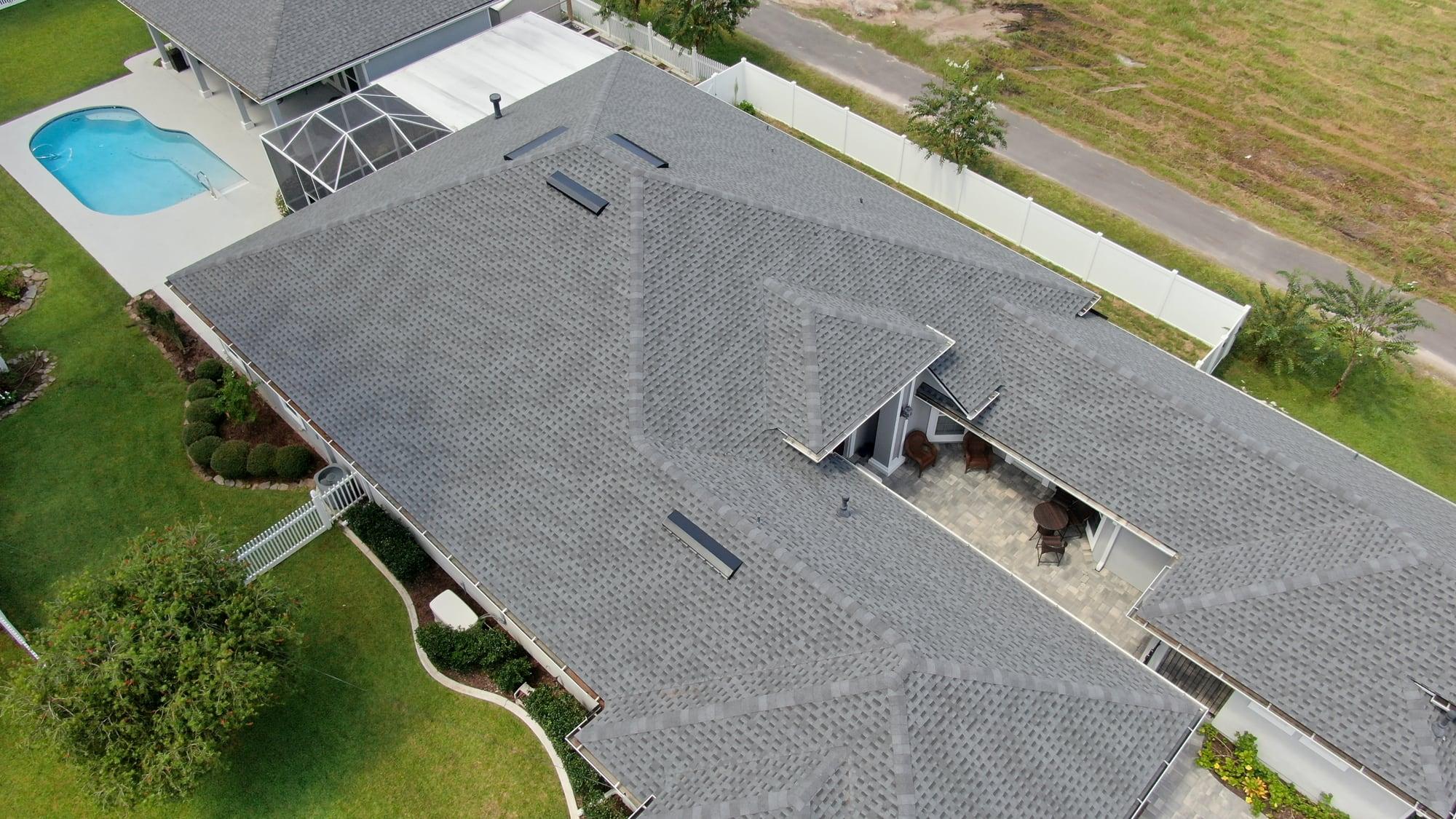
On a house that age at the coast, we are usually looking at a third roof, and the question is rarely whether the shingles are tired. It is whether the flashings, the edge metal and the deck underneath them were replaced the last two times, or just covered over.
Slightly drierthan the airport
NOAA’s 1991–2020 climate normals for the Jacksonville Beach station give 49.98 inches of rain a year across about 113 days, a shade under the 52.39 inches recorded inland at Jacksonville International.
It is the wind-driven rain that separates the beach, not the volume. Water arriving horizontally finds laps, sidewall flashings and vent collars that would never leak under rain falling straight down, which is why we water-test rather than guess at a stain.
What the beachhas actually taken
Hurricane Matthew, in October 2016, never made landfall in Florida. Its closest approach was about 50 nautical miles east-northeast of Jacksonville Beach, with the western eyewall running parallel to this coast. It still gusted to 76 mph at the Jacksonville Beach Pier, and the National Weather Service recorded significant structural damage at a surf shop on Beach Boulevard at 9th Street South that night.
Irma put another 75 mph gust on the same pier in 2017. Helene, in 2024, was the bigger wind event countywide, with 74 mph at NAS Jacksonville and 67 mph at Huguenot Park just up the coast. Florida DEP counts 10.4 miles of critically eroded beach in Duval County, which is the same weather written into the shoreline.
What we doat the beach
Jacksonville Beachquestions we get asked
No. Jacksonville Beach is a separate incorporated municipality with its own Planning and Development Department and its own Building Inspection Division on North Third Street. It publishes a dedicated Roof Permit Application and takes submissions through its own portal, C.O.A.S.T. The City of Jacksonville states that its Building Inspection Division's authority is limited to the City of Jacksonville, so a contractor who is only used to filing through JaxEPICS will be filing in the wrong place.
The city does not publish a general design wind speed, so we will not invent one for you. What is published: the Florida Building Code's 2023 wind speed map places all of Duval County between the 120 and 130 mph contours, rising toward the coast, and the beach end of the county sits at the top of that band: the City of Jacksonville sets 130 mph east of its own demarcation line, and neighbouring Neptune Beach publishes 130 mph. A 129 mph ultimate figure does appear on one official Jacksonville Beach permit checklist, but it sits under the heading for detached accessory structures, so it should not be read as a whole-house number. Your per-address answer comes from the Building Inspection Division or the ASCE 7 Hazard Tool.
Possibly, if you are close to the ocean. The wind-borne debris region covers areas within one mile of the mean high-water line where an Exposure D condition exists upwind and the ultimate design wind speed is 130 mph or greater. That describes the oceanfront strip of the Duval beaches, and it is why opening-protection requirements can apply on your block and not on one a mile inland. It is a determination the Building Inspection Division makes for a specific address, and the ASCE 7 Hazard Tool will confirm it. Note that this is not the High-Velocity Hurricane Zone. That is Broward and Miami-Dade only, and no part of Northeast Florida is in it.
The metal, usually before the shingles. Salt-laden air corrodes fasteners, drip edge, valley metal, vent collars and flashing from the outside in, so we see systems where the field of the roof still looks reasonable while the details that keep water out have quietly given up. Full, unshaded UV exposure also ages the surface faster than it does inland. When we inspect at the beach we photograph the penetrations and the edge metal first, because that is where the story usually is.
The Census Bureau's 2020–2024 American Community Survey puts Jacksonville Beach's median year of construction at 1983 across roughly 13,000 housing units, so half the city's homes are older than that. A house built in 1983 is on its second or third roof by now, and often on its second or third set of flashings too. That is a different conversation from the one we have in Nassau County, where the median build year is 2000.
Roof taking salt?We'll photograph what we find
Call or text and we'll come out, get on the roof, and send you photos of the flashings and edge metal along with a written estimate. Free, and no trip fee at the beach.
Call or text · Available 24/7