Orange Parkroofing and exterior work
Orange Park is an incorporated town, not an unincorporated stretch of Clay County. It issues its own permits, and it has older housing than Jacksonville does. Both of those change how a re-roof here actually goes.
Older roofsthan most of Jacksonville
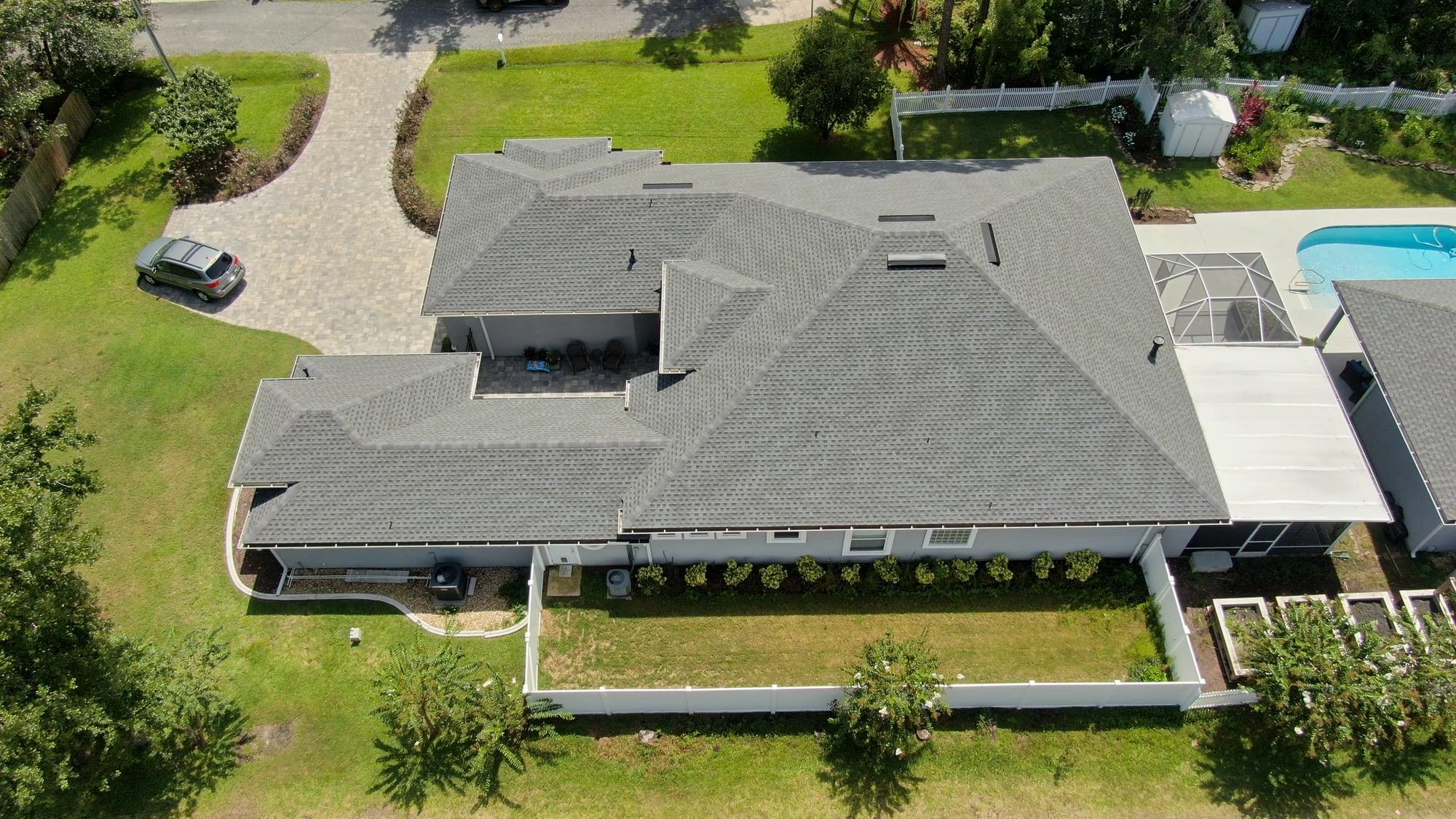
The median Orange Park home was built in 1974. That is older than the median for the City of Jacksonville, older than the Clay County median, and among the oldest community medians anywhere in our service area. Across the wider 32073 ZIP, more than half of the roughly 17,500 housing units went up before 1980.
None of that is a sales line. It is Census housing data, and it is the single most useful thing to know about roofing here. Stock that age has almost always been re-roofed at least once, sometimes twice, and what we are usually looking at is a second or third covering over decades-old decking, flashing and penetrations that nobody has opened up since.
Because we hold a Certified Building Contractor licence alongside our roofing licence, finding soft decking, rotted fascia or a failed structural detail underneath does not mean starting over with a second company.
The Town permitsits own work
A town of this size sitting inside a county with a full building division looks like it should delegate. Orange Park does not. Permit applications go to the Town of Orange Park’s Building Inspection and Permitting Division through its own online portal, and Clay County has no role in permitting inside the town limits.
Inspections are the part that trips people up. The Town contracts them out to Universal Engineering Sciences, but applications still go to the Town, which coordinates the inspection from there. Work is inspected under the 8th Edition (2023) Florida Building Code, and private provider inspections are allowed.
We file the permit, we schedule around the inspection, and you do not have to learn any of this to get a roof.
River, not oceancanopy, not salt
Orange Park fronts the St. Johns River on its west bank. That is riverine exposure, not oceanfront, so the salt corrosion that chews through fasteners and flashing at the beaches is not the dominant problem here, and Orange Park is not in the wind-borne debris region, which is at most a narrow strip along the open coast.
What it has instead is trees. The Florida Forest Service’s 2021 statewide assessment put Orange Park at 48 percent urban tree canopy. That means debris in valleys and gutters through the whole year, organic staining on shingles, and limb fall when a storm comes through. During Hurricane Matthew in 2016 the National Weather Service recorded a 47 mph gust at the Orange Park gauge, Clay County’s peak that storm was 69 mph out at Red Bay Point, and reported a tree down on a home and a vehicle here.
What we doin Orange Park
Orange Park sits in Clay County, where the county publishes its own wind zone table and requires a permit for every re-roof regardless of cost.
Orange Parkquestions we get asked
The Town. Orange Park runs its own Building Inspection and Permitting Division and Clay County does not permit inside the town limits, which surprises people who assume a town this size delegates to its county. The Town's own guidance is that all permit applications are submitted to Orange Park, and the Town then coordinates inspections with Universal Engineering Sciences, the firm that performs them. So: application to the Town, inspection by a third-party firm on the Town's behalf.
The Town of Orange Park does not publish a wind speed figure, so we will not put one in its mouth. Clay County publishes 130 mph as its county-wide ultimate design wind speed for Risk Category II, and design wind speeds across Northeast Florida generally run between 120 and 130 mph rising toward the coast. The number that actually governs your permit is the per-address value from the ASCE 7 Hazard Tool, which is what the building department works from.
That depends on the roof, not on the house, and it is a question we answer with photographs rather than opinion. A standard shingle roof in Northeast Florida can last up to about 25 years depending on maintenance, exposure and your insurer's requirements, so on a 1970s house the covering has usually been replaced at least once already and the real question is how old that covering is. We inspect, send you the photos of what we found, and tell you straight which side of the line you are on.
It is one of the bigger ones here. The state's 2021 canopy assessment put Orange Park at 48 percent tree cover, which is higher than Jacksonville's, and canopy that dense drops leaves and needles into valleys and gutters year round. Wet organic debris holds water against the roof, backs gutters up in the summer storms, and stains shingles. Limb fall in a storm is the other half of it, Hurricane Matthew put a tree onto a home and a vehicle in Orange Park in 2016.
No. Orange Park sits on the west bank of the St. Johns River, inland and well over a mile from the open coast, and the wind-borne debris region only reaches about a mile inland from the mean high-water line on the ocean. Opening-protection requirements driven by that designation do not apply here. Whether any specific address falls inside it is always a determination for the building department or the ASCE 7 Hazard Tool.
Orange Park roof?We'll come look and show you photos
Call or text us and we'll get an inspection on the schedule. Free estimate, photos of whatever we find, and no minimum trip fee.
Call or text · Available 24/7